
FELINE BEHAVIOR & HOUSEHOLD HARMONY
When your cat’s behavior changeS, or a concern has been building for some time, it can affect the emotional well-being of everyone in the home.
Feline Behavior Support offers compassionate, science-informed guidance that looks beyond the behavior itself. Together, we explore what your cat may be communicating, what is happening within the household, and what changes may help everyone feel safer, more understood, and more at ease.

Behavior does not happen in isolation
A cat’s behavior is shaped by many interconnected factors: physical health, past experiences, natural instincts, the environment, relationships, routines, available choices, and the emotional atmosphere of the home.
What may look like defiance, jealousy, stubbornness, or “bad behavior” is often an attempt to meet a need, cope with stress, seek safety, or communicate that something is not working.
My role is not to force your cat to comply or to “fix” them. It is to help you understand the behavior more fully and develop practical, compassionate ways to support change.
This means looking at the whole picture - including what your cat may need from the people who share their life.
The Whole Household Harmony Framework
The Whole Household Harmony Framework brings together feline behavior science, environmental support, nervous-system awareness, relationship-centered guidance, and respectful observation.
Rather than applying a single technique to an isolated behavior, we consider five interconnected areas.
-
Health & History
Behavioral changes can be influenced by pain, illness, mobility, sensory changes, medication, early experiences, or previous trauma. We begin by considering your cat’s health and history so that possible physical or medical contributors are not overlooked.
-
Environment & Agency
Cats need opportunities to feel safe, make choices, retreat, climb, rest, play, scratch, hunt, and move through their surroundings without unnecessary conflict. We look at how the home supports—or unintentionally limits—those natural needs.
-
Behavior & Learning
We consider what happens before, during, and after a behavior, what your cat may have learned from previous experiences, and how humane, science-based training and environmental changes can encourage new patterns.
-
Relationship & Regulation
Cats are sensitive to body language, tone, tension, routines, and the emotional responses of the people and animals around them. We explore how everyone in the household affects one another and how greater calm, predictability, and trust can support change.
-
Integration & Practice
Lasting improvement depends on bringing recommendations into everyday life. Together, we identify realistic changes that your household can practice consistently, evaluate over time, and adjust as your cat’s needs become clearer.
Concerns I May Be Able to Help With
-
Relationships Between Cats
Tension, chasing, bullying, or conflict between cats
Introducing a new cat
Reintroducing cats following conflict
Difficulty sharing resources or moving through common spaces
-
Fear, Stress & Adjustment
Fear, hiding, or difficulty feeling secure
Difficulty adjusting to people, animals, or household changes
Stress surrounding carriers, grooming, handling, or routine care
Challenges following a move, schedule change, new family member, or other transition
-
Home & Daily Life
Litter-box avoidance or other elimination concerns
Scratching or other natural behaviors occurring in unwanted places
Nighttime vocalization, wakefulness, or disruptive activity
Environmental stress, boredom, or insufficient enrichment
-
Reactive or Sensitive Behavior
Biting, swatting, or overstimulation
Defensive or stress-related responses
Difficulty recovering after frightening or frustrating experiences
Caregiver uncertainty about feline body language, communication, or emotional needs
-
Aging & Changing Needs
Changes associated with aging, illness, pain, or reduced mobility
Increased vocalization, restlessness, or changes in routine
Supporting senior or sensitive cats within a changing household
Adapting the environment as physical and emotional needs evolve
Not every concern has a purely behavioral cause. Pain, illness, sensory changes, and other medical conditions can affect behavior. When a physical condition may be contributing, veterinary evaluation will be an essential part of the process.
A Whole-Household Approach
Although your cat’s behavior may be what first brings you here, meaningful change often asks something of the entire household.
You may need to adjust routines, rearrange resources, change how family members respond, practice new skills, slow down an introduction, or reconsider expectations that do not match your cat’s needs. In a multi-cat home, the well-being and behavior of every cat must be considered… not only the one who appears to be causing the problem.
This is not about blame.
Most caregivers are doing the best they can with what they currently understand. My purpose is to help you see the situation through a wider lens and give you practical ways to move forward.
It is also important to be honest: lasting improvement rarely comes from one conversation or a single change. It grows through observation, patience, consistency, and a willingness to practice something different.
Science, Relationship, and Deeper Listening
My approach is grounded in humane, evidence-informed feline behavior practices. At the same time, behavior plans must work within real homes and real relationships.
-
Science-Informed Support
Depending on your household’s needs, recommendations may include:
Environmental changes
Enrichment
Gradual desensitization
Counterconditioning
Positive reinforcement
Resource planning
Routine adjustments
Caregiver education
-
Relationship-Centered Support
Our work may also consider:
Nervous-system awareness
The human–animal bond
Household emotional patterns
Feline body language
Nonjudgmental observation
Curiosity and responsive care
The needs of every animal and person involved
Behavior plans do not unfold in a laboratory. They unfold in living rooms, bedrooms, hallways, and kitchens—within relationships involving animals and people who may already be stressed, tired, worried, or discouraged.
Sometimes the most helpful shift begins when we slow down, observe without judgment, and become curious about what the cat in front of us is expressing.
Animal Reiki and Intuitive Observation
When appropriate, Animal Reiki and mindfulness-based practices may be gently woven into our work. These practices can support calm, presence, and compassionate observation while helping caregivers become more aware of their own energy and responses.
I may also invite you to notice impressions or subtle forms of communication that arise through careful observation and intuition.
These insights are treated as possibilities to explore—not as proven facts or substitutes for behavioral assessment, veterinary care, or other qualified professional support.
You do not need to hold any particular spiritual beliefs to benefit from this work. Recommendations will always be offered respectfully, and we can keep the process fully practical and behavior-focused if that feels right for your household.
What Working Together Asks of You
The most successful households are not the ones that carry out every recommendation perfectly. They are the ones willing to remain curious, communicate honestly, and make consistent changes.
Working together may ask you to:
Observe behavior and household patterns more closely
Share complete and accurate information about your cat’s health, history, and environment
Participate in recommended veterinary evaluation when a medical concern may be involved
Adjust aspects of the environment, schedule, or household routine
Practice new responses instead of relying on punishment or correction
Help all caregivers follow a consistent plan
Track progress and communicate when something is not working
Give your cat—and yourself—time to learn
Some situations improve quickly. Others require gradual, layered change.
Progress may include fewer incidents, less intensity, faster recovery, increased confidence, or a growing ability for everyone to share space more peacefully.
These quieter shifts matter. They are often how lasting harmony begins.

Compassionate Support Without Judgment
Living with an unresolved behavior concern can be exhausting. You may feel worried about your cat, frustrated by what is happening, embarrassed by the condition of your home, or afraid that the household cannot continue this way.
You do not need to hide those feelings here.
I approach both animals and their people with compassion. Our work is not about finding fault. It is about understanding what has been happening, identifying what can change, and creating a path forward that respects the needs and well-being of the entire household.
Veterinary and Collaborative Care
Behavior changes can sometimes be an early sign of pain, illness, cognitive change, or another medical concern. For that reason, veterinary care is an important part of responsible feline behavior support.
I may recommend a veterinary examination or ask to collaborate with your cat’s veterinarian before behavior work proceeds. In more complex situations, additional support from a veterinary behaviorist or another qualified professional may also be appropriate.
My role is to complement that care through behavior guidance, caregiver education, environmental support, and a whole-household perspective.
COLLABORATIVE CARE MAY INCLUDE
Your cat’s primary veterinarian
A veterinary behaviorist
Other qualified feline professionals
Caregivers and household members
Feline Behavior Support with Jaime
Feline Behavior Support does not diagnose or treat medical conditions and is not a replacement for veterinary care.
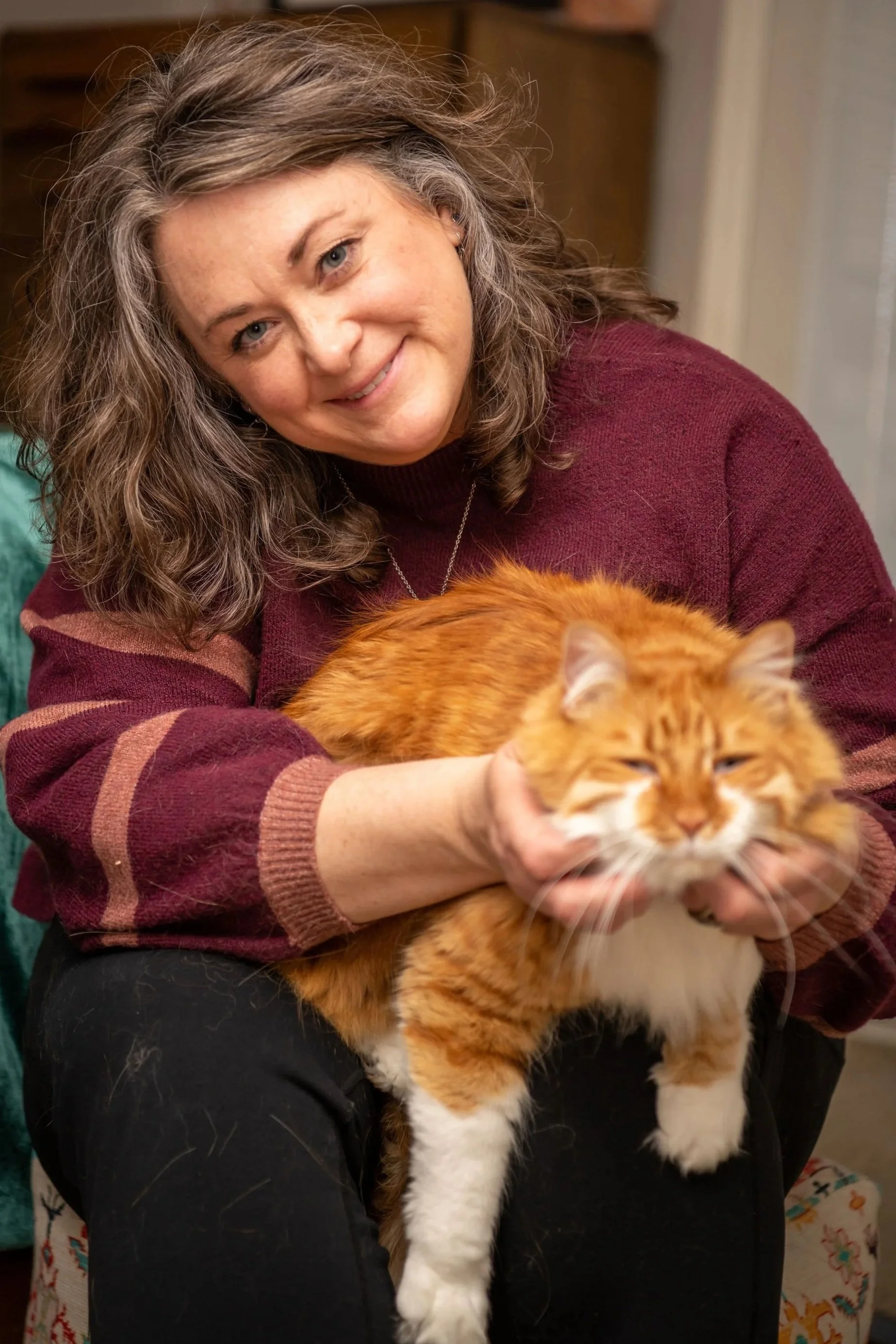
Meet Jaime
I bring together professional education in feline behavior modification, more than 100 hours spent shadowing veterinarians, years of direct caregiving experience, and extensive work centered on Animal Reiki and the human–animal bond.
Over time, I came to understand that these areas were never truly separate. Behavior, physical comfort, environment, relationships, emotion, and a sense of safety continually influence one another.
The Whole Household Harmony Framework grew from that understanding. It allows me to support cats as whole beings while also giving their people practical, informed guidance they can use in everyday life.
A More Peaceful Home Begins With Understanding
Your cat is not giving you a hard time. They may be having a hard time—and using the tools available to them to communicate, cope, or create a sense of safety.
When we meet behavior with curiosity instead of judgment, we make room for something new.
We make room for clearer communication, more thoughtful choices, renewed trust, and a home in which every member of the family has a better chance to feel secure.
If you are ready to look beyond the behavior and take an active role in creating change, I would be honored to help you begin.
Frequently Asked Questions
-
No. A behavior may be most visible in one cat, but the needs, relationships, routines, and responses of the whole household can influence what is happening. In multi-cat homes, we will consider every cat involved. Human caregivers will also be an active part of the process.
-
Depending on the concern, I may ask that your cat receive a veterinary examination before we begin or alongside our work. Pain, illness, cognitive changes, and other medical conditions can cause or contribute to behavioral changes. Addressing possible health concerns helps us build a safer and more appropriate plan.
-
No. Feline Behavior Support is grounded in humane, evidence-informed behavior practices. Animal Reiki, mindfulness, and intuitive observation may be included when they feel appropriate and welcome, but we can keep our work entirely practical and behavior-focused.
-
No ethical behavior professional can guarantee a particular outcome. Behavior is influenced by health, history, environment, relationships, learning, and the household’s ability to implement recommendations consistently. I will help you identify realistic goals and recognize meaningful progress, which may include fewer incidents, reduced intensity, faster recovery, or greater comfort and confidence.
-
Consistency among caregivers gives a behavior plan its strongest chance of success. Not every person must participate in exactly the same way, but everyone who regularly interacts with the cat should understand the plan and avoid responses that work against it. We can discuss what is realistically possible and whether meaningful progress can be supported within your household.